

A SECOND LIFE
Aprica to salvation in Switzerland 1943

“More than 200 foreign Jews who had been interned in the small Italian town of Aprica not far from the Italian-Swiss border fled successfully from almost certain annihilation in 1943. Research in archives in Italy, Switzerland and the United Kingdom helped to establish how this escape was achieved and how it was organized.”
Allan Porretti in the book “A second life : Aprica to salvation in Switzerland 1943” (2012)
“More than 200 foreign Jews who had been interned in the small Italian town of Aprica not far from the Italian-Swiss border fled successfully from almost certain annihilation in 1943. Research in archives in Italy, Switzerland and the United Kingdom helped to establish how this escape was achieved and how it was organized.”
Allan Porretti in the book “A second life : Aprica to salvation in Switzerland 1943” (2012)
THE INTERNEES
THE INTERNEES

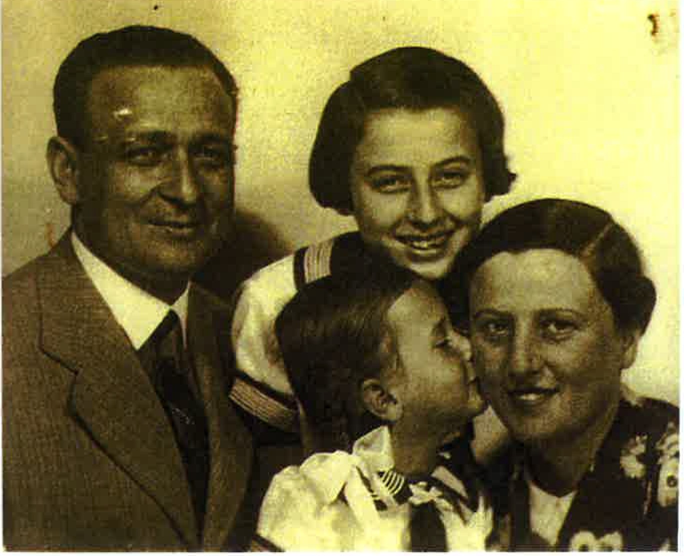
The Neufeld family in a pre-war photograph

A group of internees in Aprica
The Jewish Internees In Aprica
“After the World War II broke many Croatian Jews sought safety in Italy. Some of them were interned in the small mountain town of Aprica. Such is the story of the Neufeld family. In his testimony, Edo Neufeld has left us an account of his own experiences. With him in Aprica and then Sondrio, had been his wife, Albina Spiller and their two daughters, Lea, age 18, and Vera, age 9. Albina and her two daughters had made it safely to Susak where, following his escape from Gospic concentration camp, Edo met up with them but not for long. Edo spent around five months in Italian jails before finally arriving in Aprica in early February 1942. His wife and two daughters were able to join him a few weeks later. They were subsequently allowed to move to Sondrio on account of his health. The Italian capitulation on 8 September 1943 was not unexpected. Although at first they shared the joy of the great mass of Italian people, they soon came to senses and realised that yet again they need to pack up and flee.”
Allan Porretti in the book “A second life : Aprica to salvation in Switzerland 1943” (2012)
THE HELPERS
THE HELPERS
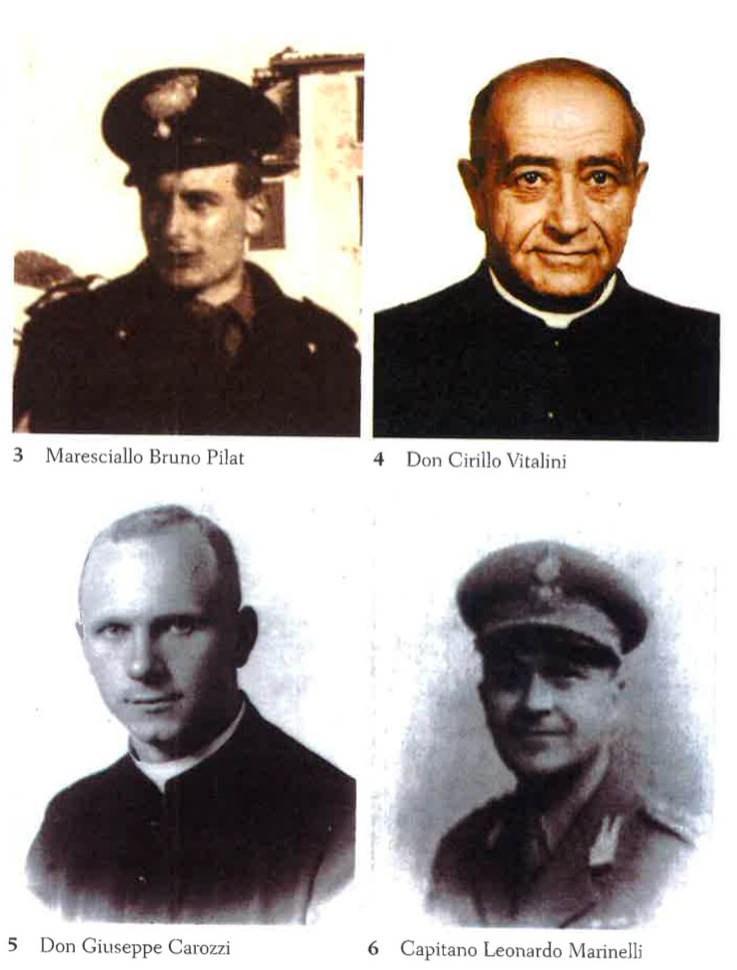
Who helped the escape?
“Many known and unknown locals helped the Jews to flee Aprica. Four of them played a distinct parts it these dramatic events. Don Giuseppe Carozzi, the organiser of that wholesale flight to salvation on 12 September 1943, don Cirillo Vitalini who responded to such great effect to the sudden appearance of that large group of exhausted and frightened people in the isolated frazione of Bratta the day before, Capitano Leonardo Marinelliwho, when asked by Carozzi to allow the fugitives to cross the border, responded immediately and positively and Brigadiere Bruno Pilat, whose decision to allow the internees to leave Aprica on the night of 10 September was the beginning of the opening act of the drama.”
Allan Porretti in the book “A second life : Aprica to salvation in Switzerland 1943” (2012)
THE ESCAPE
THE ESCAPE

From Aprica to Switzerland throught the mountains
“Being aware of the Germans approach the internees left Aprica in the evening of 10 September. For what happen to them we understand from the Swiss records. A Swiss border guard reported that early in the morning of 12 September 1943 at an altitude of 1830 meters high in the mountains on the Italian border but in Swiss territory he encountered 72 Jews who had been interned in Aprica. He ordered them to retrace their steps and return. Most refused to move and declared that they wished to remain even at the risk of being shot. The guard, although armed but faced with about sixty unarmed civilians, had to admit defeat. All he could do was to escort them to the nearest Swiss Border Post.”
Allan Porretti in the book “A second life : Aprica to salvation in Switzerland 1943” (2012)
To those who in the dark years of WW II helped the Jews persecuted by the Racial Laws and also others who sought salvation in Switzerland.

Memorial Sculpture by Giovanni Canu in the gardens of Via Elvezia in Madonna di Tirano
THE STORIES
THE STORIES
MIRO VILCEK
 “My mother (Zora Wilczek, born Bjelic) and I (Miroslav Wilczek born on 25 September 1923 now known as Miro Vilcek) left Zagreb in May 1941 to escape from the Ustashi terror. Separately we were able to reach Susak illegally. My father, Hans Wilczek, a reserve captain in the Yugoslav army, was a prisoner of war, first under the Italians, and from 1943 under the Germans. He returned to Zagreb in 1945 and died in 1946.
The Italians sent us to libero conftno (free internment): first to the province of Pesaro (Pennabilli) and later to Treviso. After the Armistice in September 1943 we went by train to Bergamo where there was a hospital for prisoners of war. My father was there, but very sick. In the chaos of that time we were able to visit him. Unfortunately he was not well enough to escape with us. Before the German occupation of Bergamo and Milan, my mother and I (together with Italian soldiers and civilians) managed to travel via Milano to Sondrio. We knew that the Pollak family and a large group of Jews were in Aprica. And that they were planning to cross over to Switzerland. We arrived in Aprica by bus on 13 September 1943, three days after most of the internees had left. But the Pollaks (lmre, Ilonka and Hedi) and a few others, including a few Slovenian political internees, were still there. We heard that all of the “Apricans” had successfully entered Switzerland and we wanted to follow.
However, that became difficult due to the arrival of the Germans in Tirano and other towns. One night the chief of carabinieri in Aprica came to the house, where we and the Pollaks were staying. He expected that the Allied troops would soon arrive in northern Italy. He asked us to write a certificate in English, stating that he had behaved correctly with the internees and that we recommend him as an honest person, etc. We were happy to oblige, but I don’t believe that was of any use. We heard that he joined the Italian partisans and lost his life.
He did us an enormous favour. At midday of 26 October 1943, the Germans came to Aprica to look for us. Apparently some fascists informed on us. The Germans first went to the police station to get information. Our carabiniere sent his little son to warn us. The Pollaks and the rest of us, got up from the dinner table and immediately left the house through the back door and found shelter in the forest. The Germans arrived very soon after, but we were gone.
We knew a peasant, who had a little mountain hut and some cows on a hill above Aprica. Five of us climbed up to it and that peasant received us well and put us in a hay barn. Ivo Pustiscek one of the Slovene political internees joined us. He was a sportsman and in excellent physical condition. He helped us. He went down to Tirano (or Villa di Tirano) to investigate the situation and to establish contact with smugglers. For him it was a hard and long walk in danger of being caught.
On 27 October 1943 Pustiscek led us into the valley and at night we crossed a bridge over the river Adda and came to a tavern on the edge of a village. There, three (I think) smugglers were waiting for us. After a short rest we went by winding paths into the cold night on a mountain. Pustiscek went with us, but he did not want to go to Switzerland, and the same night he returned to Aprica. Later we heard that with some other Slovenes he went all the way to Trieste, and had a high position with Tito’s partisans. The climb was very difficult, especially for Ilonka Pollak. It went on for hours. Paths were very narrow and right next to very steep rocky drops.
We could spot the lights of Campocologno in Switzerland. The Italian side was completely dark.
At last our passatori said that we had crossed the border and that they had to return. They left together with Pustiscek. We did not know whether we were really out of danger from German patrols.
In front of us there was no path. There was only a steep slope of small stones. lmro Pollak decided to slide down these stones and to try to get help. After a long and patient wait, we heard the alarm in Campocologno. Some time later we heard a group of soldiers coming our way. We signalled our location with a spot light. They found us and carefully lowered us down the steep slopes towards the Swiss township. That was at about 3 am on 28 October 1943. We were accommodated on hay in a large hall, where many people were sleeping. In the morning we saw around us many refugees: Italians (soldiers and civilians), escaped prisoners of war (English and American) and Jewish internees from various parts of Italy. But the breakfast was special: a full military breakfast with real coffee, real bread and best of all, Emmentaler cheese.
Swiss officers interrogated us. All five of us had sufficient proof to be considered endangered refugees. From Campocologno we were moved by the well known Bernina train to Samedan and further via Zurich to a camp in Lausanne.”
Allan Porretti in the book “A second life : Aprica to salvation in Switzerland 1943” (2012)
HEDI POLLAK
 “Hedi (born 5 May 1925 in Sisak, Croatia), with her parents lmro and Ilona Pollak, had been interned at Aprica after escaping from Croatia. Aprica, especially in summer, gave the internees some respite following the terrors of Croatia in 1941/42 and the vicissitudes of their escape to Italy. Despite restrictions on their travel, they were at times able to explore that green valley and the mountains above it. Especially among the young, many enduring friendships developed. Hedi’s brief account of her flight to safety agrees in broad outline with that of Miro Vilcek but is much less detailed. Her account, however, gives tantalising glimpses of assistance received from several local people. The priest was either don Luigi Carozzi or don Tranquillo Cederna. Cederna was forced to flee to Switzerland on 24 June 1944. Just when Carozzi was also forced to flee is uncertain, but he was certainly in Switzerland by June 1944. The carabiniere would have been Bruno Pilat or one of his men.”
Now for Hedi’s story:
“The large group of internees from Aprica and Sondrio had already escaped to Switzerland and, towards the end of October, only a few people remained. Among them were my parents and myself, Miro Vilcek and his mother Zora, a couple from Austria and several political internees. After a few days my father and I went to see the chief of police in Sondrio. He advised us to leave Aprica because we were in danger for our lives. Also he advised us to secretly move our things to Edolo. We followed this advice and moved the most needed things early in the morning with a peasant cart. Shortly after, an Italian policeman (carabiniere) from Aprica station came to tell us to leave straight away because Germans had arrived in Aprica and thar they had a list with our names on it. With the help of peasants from Aprica we went up to the summer pastures in the hills. One peasant accepted us in his hut, where we stayed for two days. A priest from Aprica brought us food, encouraged us, and promised to help us to cross from Tirano to neutral Switzerland. He kept his promise and sent us a peasant from Aprica, who took us to Tirano. Locals helped us to establish contact with smugglers whose names I don’t remember. They showed us the lights of Switzerland and then left us and returned to darkened Italy. We continued and with help from Swiss border guards arrived in Campocologno.”
Allan Porretti in the book “A second life : Aprica to salvation in Switzerland 1943” (2012)
LJERKA BLAU
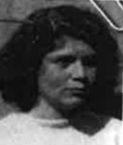 “Ljerka (Liora Harel, born 1925, Zagreb) married Darko Hrzic in Aprica, although the Swiss recorded her entry under her maiden name. They changed their family name to Harel when they emigrated to Israel, while she further changed her given name to Liora. Ljerka crossed the border on 12 September together with her parents and her husband.
Ljerka’s description of her departure emphasises, yet again, the warm relations between the internees and the aprichesi. Was the priest don Carozzi? And of course we know that Pilat was also there. Her further description can be understood as that of the group who crossed the border at Frantelone and were told by the Swiss border guard that they had to return. A little interpretation is needed: Tirano was ‘that place down in the valley which few of the internees had ever visited. The Alpini were Guardia di Finanza at the caserma at Baite Campione. Having climbed as they had, she can be forgiven for identifying the border crossing at Frantelone with the top of the Bernina. Because they were in uniform, the Swiss border guards could easily be mistaken as ‘the two fascists’.”
“So we were in Aprica till August 1943, then we heard that the Germans were coming into Italy, and we decided to go to Switzerland. My parents and I were in the biggest group of 70 people, and when we left Aprica it was very touching, because all the citizens and carabinieri accompanied us and the priest gave us his blessing. Then we went down through Tirano and climbed on the other side. After some time we met Alpini and they were very good men, and helped to take children and bring us to Alpini station. There waiting for us were other Alpini, with polenta and as we passed them, they gave everyone a piece of polenta. From this point we were alone. The whole group.
We climbed to the top of Bernina. By the way, two fascists came to us and wanted us to return. We refused, because we heard and saw the German tanks enter Tirano. Our leader and a lawyer said then that it would be death for us to return and we would rather that he would kill us now than that we would return. So they changed their mind and said if we make a mistake and came again to the wrong way, they will return us. This did not happen.
We were very thirsty so we licked the grass. After a time we knew that we were on the right way, because the path started to go down. We came to the Swiss Military Station. They gave the children something to eat, and asked the Swiss government if we can stay in Switzerland, because till then it was the biggest group of people to apply to enter to Switzerland. We waited 24 hours and then came the permission to enter in Campocologno.
There waiting for us was the Red Cross with food. From there they sent us to Samedan and from there they sent the men to a Work Camp. My mother and I were sent to Girenbad that was once a factory and now it was a Camp under the Military.”
Allan Porretti in the book “A second life : Aprica to salvation in Switzerland 1943” (2012)
IVA FEDERBUSCH
 “Iva (born 1923, Zagreb) was interned in Aprica with her parents Adolf and Malvina Jahn and her sister (born 1911, Zagreb). After marrying in Rome, she and her husband emigrated to South Africa in 1948. The trust and easy relationship between the internees and the aprichesi is easily seen in her account. That her landlady gave her money for the passatore attests to that. But Iva crossed into Switzerland 19 September 1943, five days after her sister and her parents.
Here is why.”
“On September 8th 1943 I was in Milan without an official permit so I can tell you only about my crossing into Switzerland. When the Germans came to Milan, I didn’t leave the house. I only wanted to return to my family in Aprica. I boarded a train to Sondrio without any identifying papers. I was lucky there were no checks on the train. In Sondrio a bus took me to Aprica. I arrived to an empty village. All the refugees except a handful had left for Switzerland, my family included… One of the ‘left behinds’ told me he would arrange for a smuggler to help me cross over the mountains to the border so I could join them. The landlady gave me money for the smuggler (which I returned after the war). I left my belongings with her and next day I was fetched by the smuggler in a car. I don’t remember where he took me. We left the car, and we started to walk through the woods on a mountain. After some time he told me to continue walking on the narrow path, and I would see the Swiss border post on my left side, and then he left. I continued walking with a small suitcase and my mother’s fur coat, but I saw nothing. After a time the coat slipped from my grasp. I climbed down a short way to retrieve it, and it was then that I saw the border post, already behind me. I climbed down to it, to the amazement of the guards, because I arrived from the wrong side!
As was typical with all the others, I spent a day at the border post, a few days at a transit camp and then joined my family in quarantine at a camp. We were then transferred to an ex-children’s home, where we lived freely. The Swiss commander was very humane, singing with us and telling stories. I heard that he cried when he was transferred from the camp.
In January 1944 I began to work as a house maid to a Swiss family in Zurich, and stayed there until the end of the war. Then my boyfriend from Zagreb came to fetch me. At that time he was living in Rome so I crossed the Swiss-Italian border again illegally for the third time! But that was a laugh. We married in Rome and came to South Africa in 1948. My father died in Switzerland and my mother and sister returned to Zagreb.”
Allan Porretti in the book “A second life : Aprica to salvation in Switzerland 1943” (2012)
ANDRE KORNHAUSER
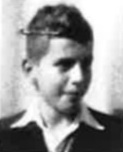 “Andre (Andrij, born 1930) crossed the border with his parents Desider (born 1891) and Magda Gombos (born 1902), and his older brother Pavao (born 1924). His father was suffering from diabetes which had been exacerbated by five months in jail before he was permitted to join his family at Aprica in May 1942. Again Andre’s description indicates that they were part of the large group who crossed the border at Frantelone on 12 September and emphasises the terrible effort demanded of the old and those in poor health who were in that group.”
“After the capitulation of Italy to the western Allies on 8 September 1943 we left with the first group to head for Switzerland: at night and down to the valley of the Adda river. The next part of the journey was dramatic. We had to climb up the Alpi retiche to the Swiss border, with our remaining personal belongings on our backs. My father had a few serious crises, and so did other older or weaker people in the group. I do not know how many individuals were in our group, I would guess 20 or more. At the Swiss border the Swiss military who were stationed there would not let us enter. (We did not meet any Italian border police, or similar). However we refused to return to Italy. After a long wait in the open and pretty cold temperatures, we were finally allowed to enter the country and escorted to a receiving camp in Campocologno. From there we were transported, with a number of fellow internees, to Girenbad, (Zurich Canton).
It was a nightmare journey, and a miracle that we survived. It was a combination of luck, and the great energy, intelligence and courage of my mother who never gave up. My father died March 22, 1945 in Ruti (Zurich Canton).”
Allan Porretti in the book “A second life : Aprica to salvation in Switzerland 1943” (2012)
THE NEUFELD FAMILY
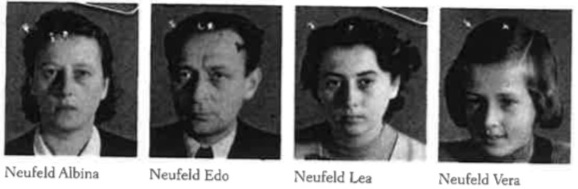
“The escape to Switzerland from Sondrio of the Neufeld family (Edo, his wife Albina Spiller and his daughters, Lea and Vera) was a true odyssey that extended over three or possibly four days. Edo in his testimony covers it very briefly indeed. Vera remembers things that a nine-year-old might notice. Lea’s account is also brief. But we have some details of their first day’s attempt from Vito Chiaravallotti, a mathematics teacher in Sondrio at the time, who knew the family when they were living in Sondrio.”
Vito Chiaravallotti’s account
“The 12-13 September, the Neufelds decided to go to Switzerland with another family. They had already arranged this with two young passatori from Montagna. Lea asked me to go with them. She felt that it would be safer that way. I did not know the area and the sentieri that went to the border. We left in the morning and we walked all day. In the evening, the two passatori, without any warning, left us. We passed the night in the open and in the morning, not knowing where to go, we descended towards the valley. Fortunately after a few minutes we found ourselves at San Bernardo, but the few houses were all shut up. I told them to stay there and wait for me. I returned after two hours with a contadino who knew the area, but the Neufelds had disappeared. I learnt many years later that they had been helped by two young men. The 20 September, I too, fled to Switzerland. It had become too dangerous to remain, since my friendship with the Jewish families was known to the fascists.”
What happened to them on the succeeding three days can only be guessed at. Lea, writing of this, said that:
“Several times smugglers deceived us and for three days we wandered around. We had to evade Italian border patrols. but the fourth time we succeeded. Partly we had to crawl not to be noticed by Germans, who were below us and not far away. We crossed the border at Campocologno. My father had a heart attack and could walk no further. A Swiss soldier came to us to help. We were very happy when we saw him coming towards us. He carried a basket full of grapes. This soldier helped my father to walk downhill and also helped us by carrying some of our luggage.”
Eda’s account is similarly brief:
“We left by foot from Sondrio and climbed to a height of 2,000 meters in the mountains near the Swiss border. But we had been misled by the smugglers and during three days of aimless wandering we were twice arrested by the Italian border guards, although both times they released us as they had received no instructions. There were some unfortunate incidents in our flight from Italy, however I have described it only briefly because it was similar to that of thousands of others and you [his audience] will have been able to read of many of these in the daily press. Having for the fourth and last time found the way to the border and said goodbye to the passatori, as we passed the stone border post we began to breathe more easily. Tears of relief filled our eyes as we came to the Swiss border guard who had been watching us with his binoculars from some distance and who then offered us some grapes.”
Allan Porretti in the book “A second life : Aprica to salvation in Switzerland 1943” (2012)